







' fill='%231ec7e2'/%3E%3C/svg%3E)



September 8, 2025 | By: Reid Murphy
This story is part of a collaborative project between Project: Cold Case and the University of North Florida’s Applied Journalism class.
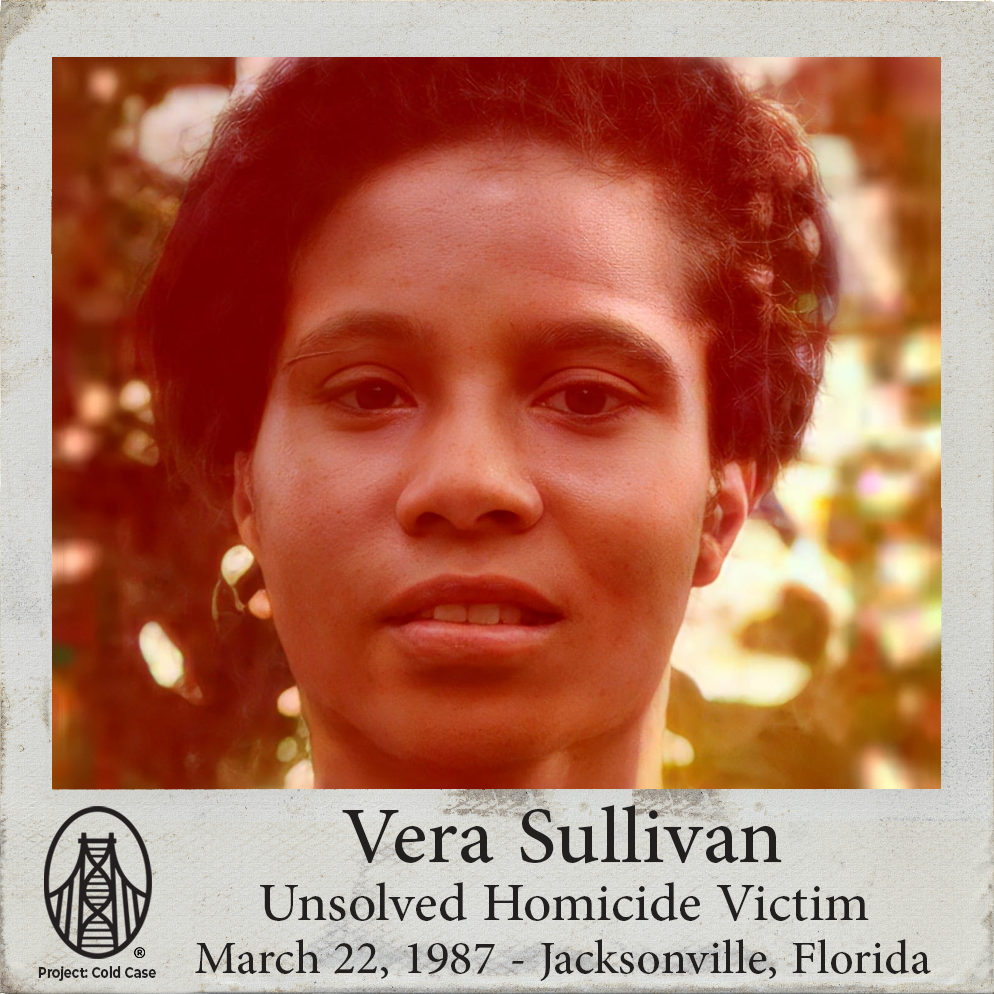
Those who knew Vera Sullivan remember her exceptional beauty and class, but to her five children, she was that, and so much more. Whether she was trying to get someone to laugh, sharing her love for music, or making a home-cooked meal, Vera had an enormous heart. “She did not deserve what happened to her,” said Tamica Jackson, Vera’s daughter.
On March 3, 1987, 37-year-old Vera Sullivan was reported missing. She was last seen getting off the bus in Jacksonville, Florida, on her way home from work, but never made it to her home on the Northside. Nineteen days later, on March 22, Vera’s body was discovered rolled up in a carpet and discarded in a wooded area near Clanzel T. Brown Park near Moncrief Road. The circumstances of her death remain a mystery.
Vera grew up in a lively home in Jacksonville, Florida. She was one of 13 children and was known for always remaining loving, and solemnly arguing with her siblings. Her daughter Tamica recalls hearing stories of her mother and aunts swapping clothes and shoes; they were very close. Around the age of 17, Vera got married to her first husband, a military member. Together they were deployed for a stretch in the Pacific, living on military bases in Hawaii and Japan. They shared four children together but divorced in the mid ‘70s. She returned to Jacksonville and worked for many years as the maître d’ of the Seminole Club, Jacksonville’s oldest social club for men and the seventh oldest of its type in the country. “She was a respectable woman; she had a good life even though it was rough at times,” said Tamica.
Tamica remembers in detail the day her mother’s body was found. She was home with her father; it was a Sunday. The family had reported Vera missing soon after she did not arrive home from work on March 3. The children had not been told of their mother’s disappearance; Tamica was only about 7 years old. “Things had been weird for the previous couple of weeks,” she said. She noticed the uneasiness of her family and could feel that something was wrong. She describes her father as being “more guarded,” and he wouldn’t let the kids play anywhere without adult supervision.
On that Sunday, March 22, the phone rang. It was Tamica’s grandfather. Tamica was immediately suspicious because it was usually her grandmother who did the calling. She passed the phone to her father and took a step back, watching as her dad’s eyes welled up with tears.
Tamica’s father and mother met in the late ‘70s and never married, but they co-parented with grace. He was often worried about her when she made her way home from work late at night and frequently offered to drive her.
Still unsure of what had happened, Tamica watched as her father went to retrieve his shotgun and headed towards the door. “Tamica, don’t open this door for nobody,” he said. She remembers feeling confused and slightly hurt- he never used such a stern tone with her. She vividly remembers the sound of his car speeding away, the helicopters overhead, and the sound of sirens just a few blocks away.
Her father came home around 4 p.m. She remembers this because it was before the afternoon news came on. He sat her down on her bed and explained to her that her mother was dead. Her screams and cries were so loud and raised so much alarm that the neighbors came over to make sure she wasn’t in danger. The news broke at 6 p.m. Tamica and her family members watched with the rest of Jacksonville as the murder of Vera Sullivan was reported live.
Vera was a small woman, only about 120 lbs., but she “packed a punch,” as Tamica says. She was known to carry a handgun, which was no longer in her purse when her body was found. “If she felt like she was in danger, she would have used it,” said Tamica.
Tamica also shared that a necklace of her mother’s was hung on the doorknob of their family’s home after she had gone missing. These anecdotes from the case lead Tamica to believe that the killer may have been someone the family knew. Many suspects were investigated, but none have ever panned out.
Life was hard for Tamica and her siblings after their mother’s death. Just four years later, she lost her father to a heart attack. She bounced back and forth between relatives and struggled to navigate life as an orphan. Eventually, she took the steps to become an emancipated minor. “My childhood ended the day my mom died,” she said.
Tamica feels the absence of her mother every day- especially when she hears songs from Luther Vandross, one of her mother’s favorite musicians, or as she watches the children in her family grow up. She is left with endless “why” questions. “Why her? Why my momma? Why did they think so little of her life?” she asks. Despite almost 40 years of searching, she still holds hope that the killer will be found and that her mother will receive the justice she deserves.
If you have any information regarding Vera Sullivan’s unsolved homicide, please call the Jacksonville Sheriff’s Office at (904) 630-0500. To remain anonymous and possibly receive a cash reward up to $3,000, call First Coast Crime Stoppers at (866) 845-TIPS (8477).
Original Spotlight published on October 23, 2017 | By Carole Hawkins
Tamica Jackson recalls many details of her early childhood, even though it’s been more that 30 years since those times. Those years growing up in Northwest Jacksonville surrounded by her father, mother, two older brothers and two older sisters.
Some memories are of her mother kissing her on the forehead, dancing with her in the living room, putting her to bed every night when she had chickenpox, the smell of corned beef and cabbage cooking on the stove.
There are other memories Tamica will never have.
Of her mother sending her off to the prom, comforting her the first time a boy broke her heart, welcoming four grandchildren into the world.
One memory Tamica will absolutely never forget is the day everything changed. She was 8 years old.
Vera Sullivan worked as the head maitre de at the Seminole Club in Downtown Jacksonville. On March 3, 1987, she never made it there. Vera’s boss told police she was a dependable employee. It was not like her to miss a shift.
She was last seen at the bus stop at 36th Street and Moncrief Road, according to the Jacksonville Sheriff’s Office. She was wearing a black skirt, white blouse, white shoes and gold earrings.
On March 22, Vera’s body was found, wrapped in some type of fabric and lying in a wooded area behind Clantzel Brown Park, near the intersection of Moncrief Road and Golfair Boulevard.
Vera rode the bus every day, so other riders knew her and several came forward. But none of the tips led police to who killed her, according to the Jacksonville Sheriff’s Office.
The family had reported Vera missing, but kept the news from her children. Tamica thought her mother was out of town.
She was playing in the yard with her best friend when she realized something was wrong. Tamica’s dad pulled up the driveway in a hurry. He ran into the bedroom and grabbed his shotgun and some shells.
“I was like, ‘Whoa, what’s going on?” she said.
“Stay in the house! Don’t move. Don’t open the door for nobody, and lock the door behind me!” her father said.
“Why daddy?”
“Just do it!”
It wasn’t normal for her father to yell. There were tears in his eyes. Then, Tamica looked up and saw a police helicopter and heard sirens. Later, her father came home and took her into the bedroom.
“I’ve got something to tell you about your Mama,” he said.
His eyes filled with tears again, and Tamica thought perhaps her daddy and mama had had a squabble. Maybe she had left him.
“It’s OK. Everything’s going to be OK,” Tamica said.
“That’s not it baby,” her father said. “They found your mom and somebody killed her.”
Tamica screamed so loudly, the neighbors thought she was being attacked. They came to the house, saw her father consoling her, and knew the worst had happened.
The loss became bigger. Tamica’s older siblings had a different father. With Vera gone, the kids were split apart.
Three years later, Tamica’s father died. At 11 years old, both her parents were gone.
For years, she bounced between the homes of family members. Then at 16, she became an emancipated minor.
Within a week after Vera’s body was found, police released a composite sketch of a man they wanted to question.
Years later, Tamica said the family has pushed twice to have her mother’s case reopened.
Once, came when Tamica was a young mother. She said a well-meaning officer who worried for her safety told her she had two beautiful babies, and perhaps she should get on with her life.
In 2008, the family again wanted police to reopen the case. A childhood friend of her brother had been serving time for armed robbery. He wrote a letter to Tamica’s sister saying he knew what happened and it had been bothering him.
“He had knowledge of the case that police had never told the public,” Tamica said.
She believed either he was there as a witness or he did it. She said three people he named were brought in for questioning. But negotiations fell apart when the man wasn’t granted immunity.
The Jacksonville Sheriff’s Office confirmed the case was reopened, but could not discuss the investigation in order to maintain the integrity of the case.
Tamica said she has tossed and turned every night since that day in March 1987.
“I think it would help me if I knew what happened to her. To serve notice that, what you did, it was not OK,” she said.
Through her teen years, Tamica never spoke of the mother she lost. It was too painful for her grandma to talk with her about it. So, Tamica shut down instead.
Then when she was 25, Tamica’s children started asking about their grandparents. It took her awhile to open up. But now, she’s talked to her kids a lot.
So much so that one day, when Tamica’s daughter answered the phone and learned the caller wanted to know about Vera Sullivan, the girl said, “Oh, that’s my grandma.”
Remembering the stories of kisses, cooking and dancing of a woman she’s never met.
Please use the buttons below to share this case in hopes that someone, somewhere, will come forward and give this victim and family the answers they need and the justice they deserve.
If you have a loved one who is the victim of an unsolved homicide, please submit their case here for consideration in a future Cold Case Spotlight post.
Tampa Bay Times - April 8, 1987
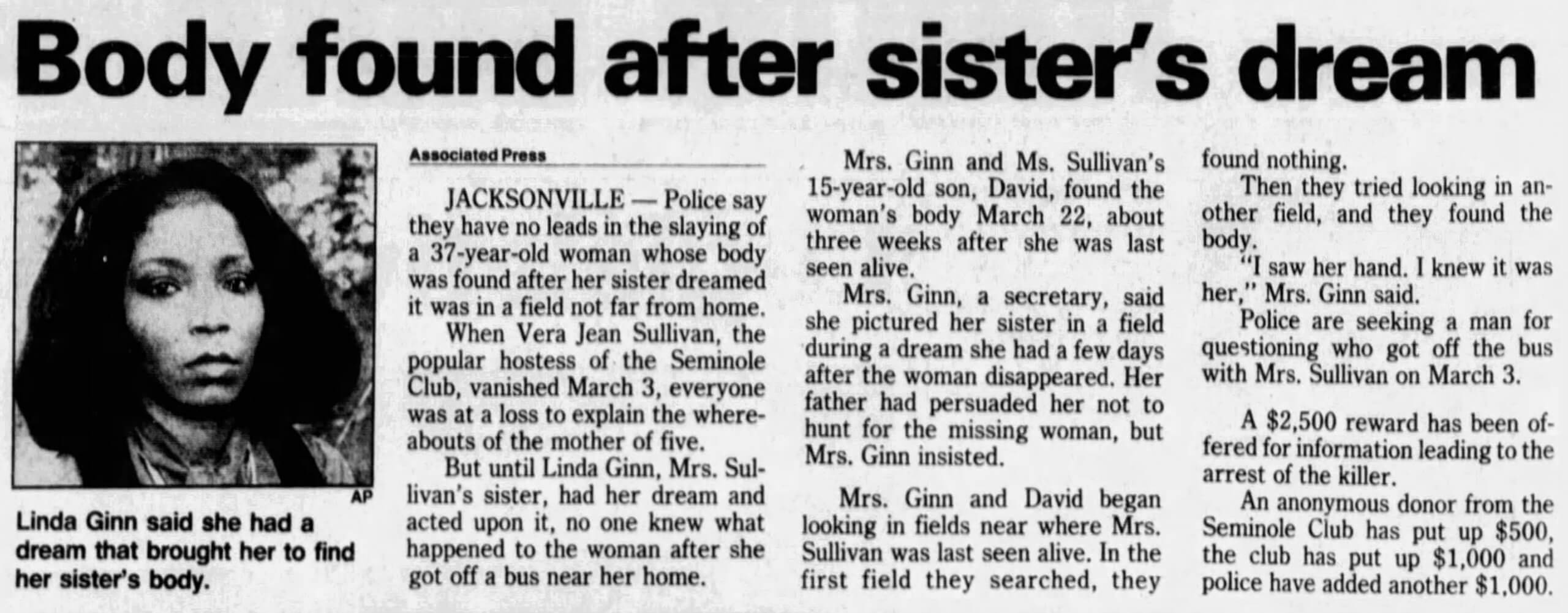
Tallahassee Democrat - April 8, 1987

News Clipping from family


Image provided by the family of Vera Sullivan


